
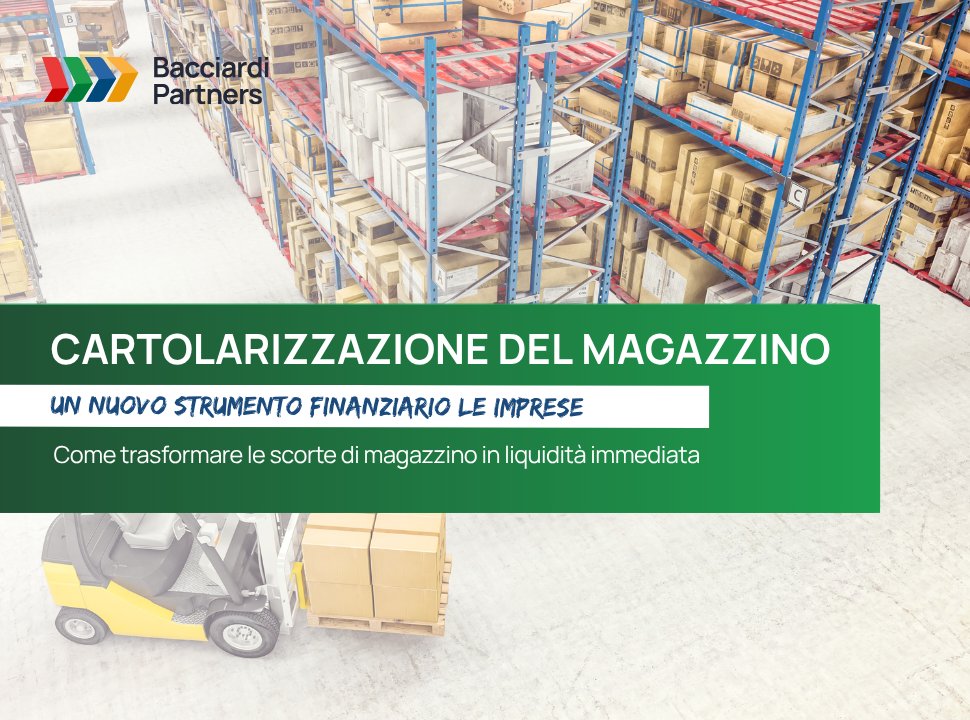
 A recent legislative development opens up new opportunities for companies operating with long production cycles or managing substantial inventory levels.
With Law No. 34 of 11 March 2026 (the so‑called Annual SME Law), the Italian legislator has, for the first time, extended securitisation to unregistered movable assets, expressly including inventory stock.
The new regime, in force as of 7 April 2026, makes it possible to view inventory not only as a working capital item, but also as a potential source of liquidity, without resorting to additional bank debt. This represents an entirely new scenario for manufacturing companies, retailers and the Made in Italy sectors.
But in which cases can this instrument be truly effective? Which companies can derive a concrete benefit from it? And which aspects require careful assessment from a financial, operational and legal standpoint?
It is precisely on this ground that inventory securitisation ceases to be merely a regulatory innovation and becomes a potentially significant lever within a company’s financial strategy.
What It Is
Inventory securitisation allows a company to segregate inventory assets and definitively transfer ownership to a special purpose vehicle (SPV), which purchases the goods and finances the acquisition through the issuance of securities to investors.
The outcome is immediate liquidity, balance sheet optimisation, no new bank debt, and the transfer of part of the unsold inventory risk to the investors.
Who It Is For
Inventory securitisation is primarily aimed at two categories of companies:
1. Companies with structurally long financial cycles
A financial cycle exceeding 12 months, from payment for raw materials to cash collection from sales, inherently linked to the production process, resulting in a revolving financing need.
Examples include wine producers and manufacturers of aged food products such as cheese (e.g. Parmigiano Reggiano) and cured meats (e.g. prosciutto).
2. Companies with excess inventory and slow turnover
Inventory that remains saleable but with slow rotation (12–24 months) and typically sold at discounted prices, generating a one‑off financing need.
These companies, often due to market conditions, hold excess stock compared to current commercial demand, with disposal typically occurring through secondary, non‑full‑price channels such as outlets, specialised e‑commerce platforms or secondary markets.
Typical examples include fashion and apparel manufacturers and retailers.
Financial Objectives
The management objectives of inventory securitisation vary depending on the company profile:
Companies with structurally long financial cycles:
- Diversification of funding sources away from traditional bank lending
- Reduction of overall financing costs
- Increase in debt capacity to support business development and investment
Companies with excess, slow‑moving inventory and a one‑off financing need:
- Recovery of the investment in inventory, at least at cost
- Release of financial resources for ongoing operations
Why It Can Be Advantageous
Key Benefits
- Immediate liquidity without capital increases or additional bank debt
- Improvement of key financial ratios (ROE, ROA, Net Debt/EBITDA) and bank covenants
- Preservation of credit lines for strategic uses
- No additional financial covenants imposed on the company’s balance sheet
- Potential tax deductibility of inventory impairment provisions
Points to Be Carefully Assessed
- Structuring and advisory costs
- Logistical management of the transferred goods, whether held by the originator or third‑party warehouses, requiring robust inventory procedures and dedicated IT reporting systems
- Reputational risk in the event of improper communication of the transaction
- Medium‑to‑high operational complexity compared to standard bank financing
- Residual unsold inventory risk, which is not entirely transferred to the SPV
In this context, inventory securitisation should not be viewed as a standard solution, but rather as a tailor‑made instrument to be assessed in light of the company’s specific characteristics, the quality of its inventory, its financial structure and its strategic objectives.
For this reason, the actual effectiveness of the transaction depends on the ability to structure it correctly from the outset, by assessing its sustainability, expected benefits and key risk areas.
Our Services: Support at Every Stage
Bacciardi Partners has developed an **integrated expertise** covering the entire transaction lifecycle, from the initial assessment through to contractual closing and ongoing operational management.
01. Financial Needs Analysis
We assess the compatibility of your balance sheet structure, organisational setup, logistics and inventory analytics with the transaction. We also model pre‑ and post‑securitisation scenarios, including the impact on key financial ratios, creditworthiness and cost of equity.
02. Selection of the Financial Partner
We identify and select arrangers, servicers and institutional investors from leading market players and specialised destocking platforms, based on the specific features of the proposed transaction.
03. Financial and Legal Due Diligence
Analysis of inventory ageing, turnover ratios and classification of transferable stock, excluding non‑eligible items. Assessment of impairment provisions and disposal losses, and verification of compliance with **IFRS 9**, **Law 130/1999** and **Law 34/2026**.
04. Inventory Sale Agreement
Drafting and negotiation of the sale agreement, with verification of the **true sale** requirements to achieve off‑balance‑sheet derecognition for the Originator.
Structuring of SPV sales channels (including the originator, regular customers and secondary channels).
Clauses governing profitability protection, performance fees, volume discounts and rights of first refusal.
05. Logistical Management of the Transferred Inventory (Service Agreement)
Definition of custody models, either through physically segregated in‑house warehouses or third‑party facilities, and the related logistics service agreements, consignment stock and call‑off stock arrangements, ensuring full physical and accounting segregation.
06. Tax Structuring
Definition of the tax structure of the transaction and assessment of potential tax risks.
Want to Learn More?
Bacciardi Partners offers a **multidisciplinary team** with integrated financial, legal, tax and operational expertise to support companies in the preliminary assessment of this instrument and in determining its practical applicability.
Our professionals are available to explore the topic in greater depth and to jointly evaluate whether inventory securitisation represents a solution aligned with the structure, needs and objectives of your company.
Lorenzo Bacciardi, CEO, Bacciardi Partners
Pier Federico Orciari, Head of Corporate Law, Bacciardi Partners
Francesco Todaro, Of Counsel – Special Situations, Bacciardi Partners